Welcome to Low Cinema
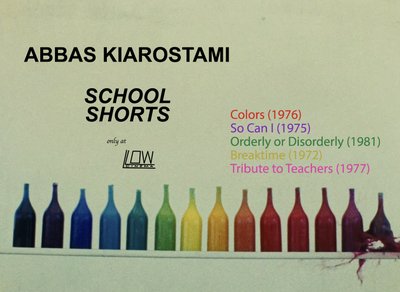
Dir. Abbas Kiarostami, Iran, 70 minutes total
Come enjoy these short films by Abbas Kiarostami! Great for both kids and adults
Program:
"Colors" - 1976, Iran, 15 min., Persian with English subtitles
Ostensibly also a film for children, this picture-book essay about the range of hues that brighten our world has the air of a delightfully playful formalistic exercise. As a narrator runs though the colors one by one, Kiarostami shows us where each appears in nature and human life (which occasions some great views of prerevolutionary consumer culture in Iran). Of course, a little boy is featured—in one memorable sequence, he fantasizes about being a race-car driver.
"Orderly or Disorderly" - 1981, Iran, 17 min., Persian with English subtitles
The first shot shows students descending a staircase in calm, orderly fashion, then the second details the same action as a chaotic rush. Separated by slates and Kiarostami’s voice intoning, “Sound, camera,” subsequent sequences describe the same dichotomous behavior in a schoolyard, on a school bus, and in the haphazard traffic of Tehran. Kiarostami described this as “a truly educational film,” but it plays more like a quirky philosophic aside.
"So Can I" - 1975, Iran, 4 min., Persian with English subtitles
The first of Kiarostami’s films made for, rather than about, children was an experiment in combining live action and animation, done in collaboration with animator Nafiseh Riahi. As two schoolboys watch animated views of animals’ actions—kangaroos jumping, fish swimming, etc.—one boy (played by Riahi’s son Kamal) says, “I can, too,” and imitates the actions. The music is sprightly, the mood fun. The second boy is Kiarostami’s son Ahmad.
"Breaktime" - 1972, Iran, 15 min., Persian with English subtitles
Disciplined at school for breaking a window, a boy joins throngs of his schoolmates as they make a cacophonous exit into Tehran’s streets. He then briefly joins an impromptu soccer game but disrupts it by stealing the ball and running away, and ends up drifting aimlessly along a busy highway. Free of dialogue but using nonsynchronous concrete sound throughout, this moody film shows Kiarostami expanding his visual vocabulary with zooms and crane and helicopter shots.
"Tribute to Teachers" - 1977, Iran, 17 min., Persian with English subtitles
An assignment from the Ministry of Education, this documentary from the last years of the Pahlavi dynasty includes interviews with officials who predictably praise teaching as a sacred, noble, and honorable profession. The teachers who are also interviewed are less starry-eyed; one speaks of ungrateful students and the job’s poor pay. The contrasting views express Kiarostami’s interest in education while registering some of his reservations about how it is practiced.
All sales are final; no refunds or exchanges. Five minutes after the listed showtime, any unused tickets will be considered no-shows and released to standby customers.
Abbas Kiarostami - School Shorts
No upcoming showings scheduled for this movie.
View All ShowingsDir. Abbas Kiarostami, Iran, 70 minutes total
Come enjoy these short films by Abbas Kiarostami! Great for both kids and adults
Program:
"Colors" - 1976, Iran, 15 min., Persian with English subtitles
Ostensibly also a film for children, this picture-book essay about the range of hues that brighten our world has the air of a delightfully playful formalistic exercise. As a narrator runs though the colors one by one, Kiarostami shows us where each appears in nature and human life (which occasions some great views of prerevolutionary consumer culture in Iran). Of course, a little boy is featured—in one memorable sequence, he fantasizes about being a race-car driver.
"Orderly or Disorderly" - 1981, Iran, 17 min., Persian with English subtitles
The first shot shows students descending a staircase in calm, orderly fashion, then the second details the same action as a chaotic rush. Separated by slates and Kiarostami’s voice intoning, “Sound, camera,” subsequent sequences describe the same dichotomous behavior in a schoolyard, on a school bus, and in the haphazard traffic of Tehran. Kiarostami described this as “a truly educational film,” but it plays more like a quirky philosophic aside.
"So Can I" - 1975, Iran, 4 min., Persian with English subtitles
The first of Kiarostami’s films made for, rather than about, children was an experiment in combining live action and animation, done in collaboration with animator Nafiseh Riahi. As two schoolboys watch animated views of animals’ actions—kangaroos jumping, fish swimming, etc.—one boy (played by Riahi’s son Kamal) says, “I can, too,” and imitates the actions. The music is sprightly, the mood fun. The second boy is Kiarostami’s son Ahmad.
"Breaktime" - 1972, Iran, 15 min., Persian with English subtitles
Disciplined at school for breaking a window, a boy joins throngs of his schoolmates as they make a cacophonous exit into Tehran’s streets. He then briefly joins an impromptu soccer game but disrupts it by stealing the ball and running away, and ends up drifting aimlessly along a busy highway. Free of dialogue but using nonsynchronous concrete sound throughout, this moody film shows Kiarostami expanding his visual vocabulary with zooms and crane and helicopter shots.
"Tribute to Teachers" - 1977, Iran, 17 min., Persian with English subtitles
An assignment from the Ministry of Education, this documentary from the last years of the Pahlavi dynasty includes interviews with officials who predictably praise teaching as a sacred, noble, and honorable profession. The teachers who are also interviewed are less starry-eyed; one speaks of ungrateful students and the job’s poor pay. The contrasting views express Kiarostami’s interest in education while registering some of his reservations about how it is practiced.
All sales are final; no refunds or exchanges. Five minutes after the listed showtime, any unused tickets will be considered no-shows and released to standby customers.